





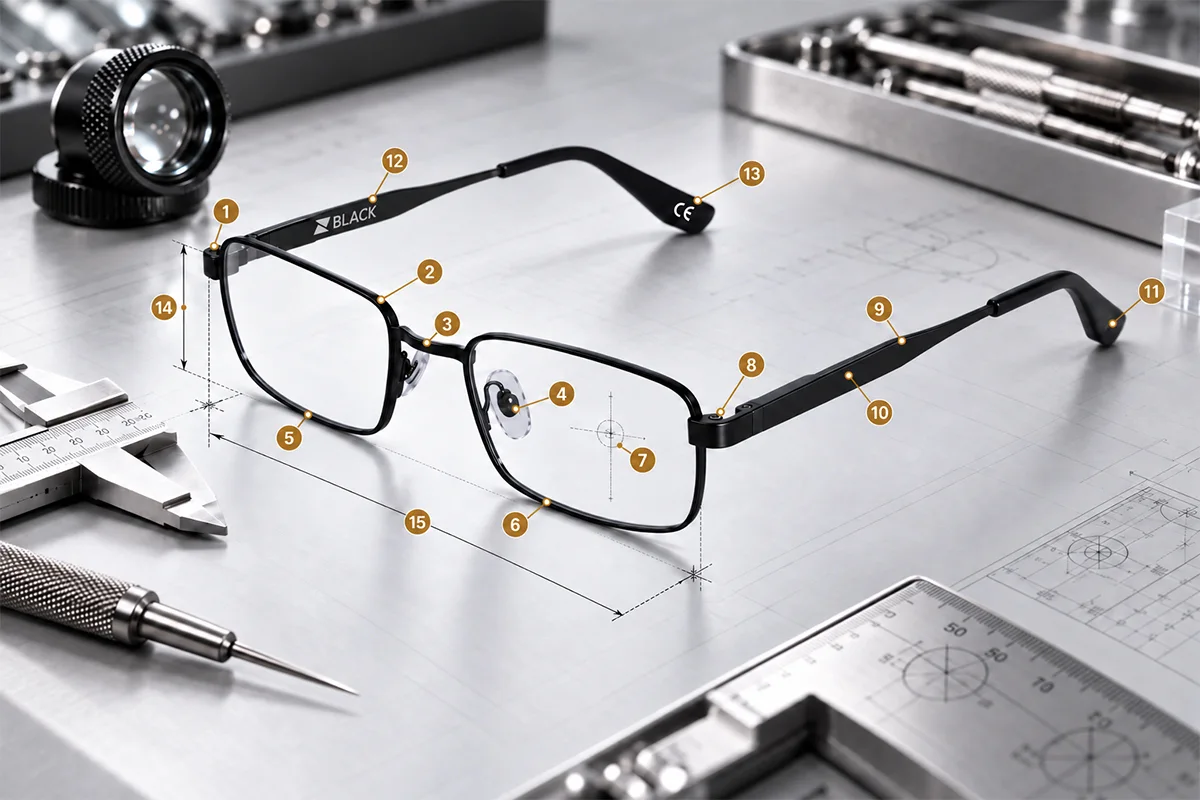

15 Essential Quality Checks for Eyeglass Frames
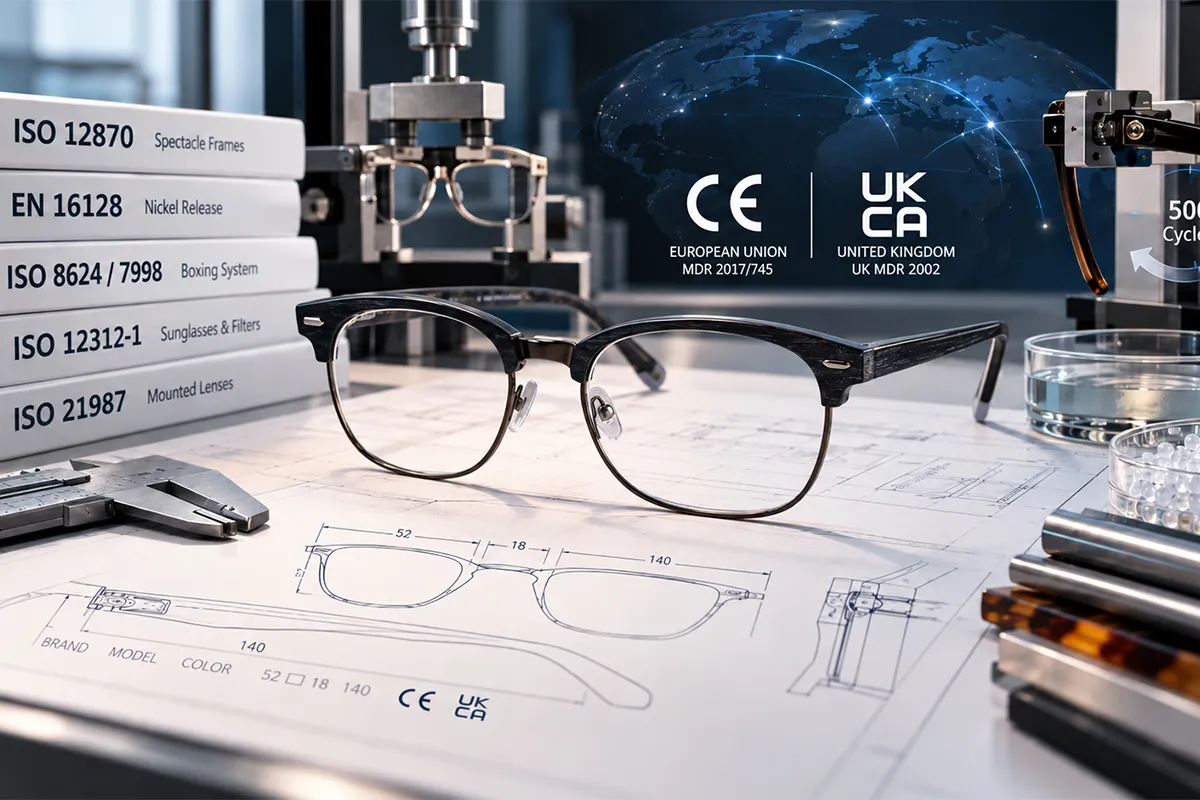
In our facility, inspection and QC begin the moment materials arrive and continue through every production stage. Incoming materials are checked against specifications, in-process inspections catch deviations early, and final testing verifies that each product meets our standards before shipping. All results are documented, so any issue can be traced and corrected quickly. This layered approach ensures the consistent quality and reliability customers expect when sourcing the best wholesale optical frames, keeping them confident in every order.
-
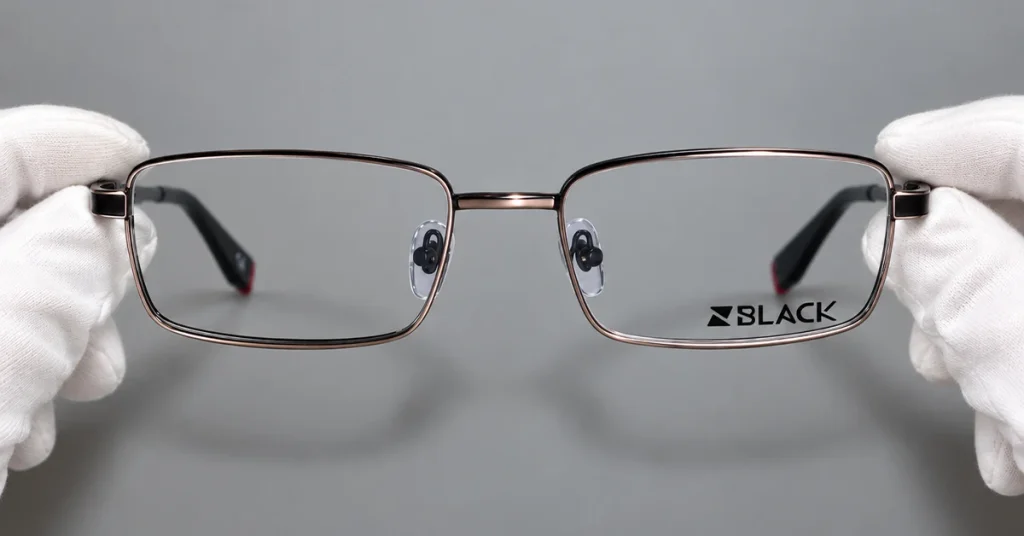
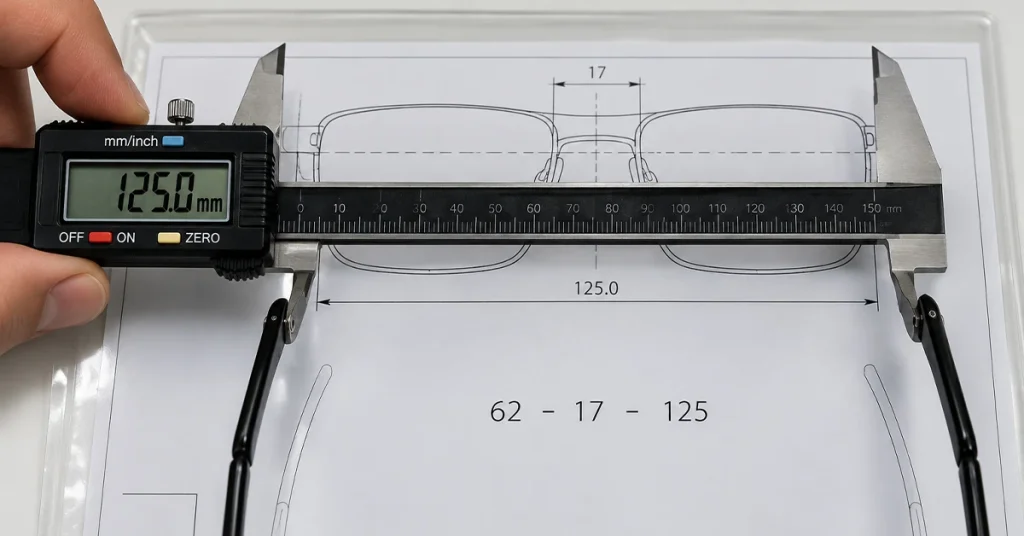
Checking Model, Size, Color, and Quantity (100% Inspection)
- A: The frame’s model must match what’s specified in the sample drawings.
- B: Dimensional tolerances for metal frames: Position A ±0.2mm, Position B ±0.2mm; CIR ±0.33mm; DBL ±0.5mm; ED ±0.2mm; temple length ±2mm. For acetate frames: Position A ±0.3mm, Position B ±0.3mm; CIR ±0.7mm; DBL ±0.5mm; ED ±0.3mm; temple length ±2mm.
- C: Color must align with both the order specifications and the approved sample.
- D: Quantity received must match what was actually ordered.
-
Optical Testing of Frames (100% Inspection)
- A: The filter coefficient must meet production specifications.
- B: Optical parameters must conform to standard requirements.
- C: Position the frame on the outer edge of the optical tester’s three positioning brackets, simulating how it would sit on an actual wearer.
- D: A pass requires at least two of the readings on the tester’s screen to show PASS; two or more FAIL readings mean the item is defective. Both CLASS1 and CLASS2 count as passing, though a CLASS2 result signals that improvement is still needed.
-
Eye-Rim Shape Standard (AQL 1.5)
The master lens must meet standard dimensional tolerances, verified through trial-fitting against standard reference sheets.
-
Welding Strength Standards (5 pairs per batch)
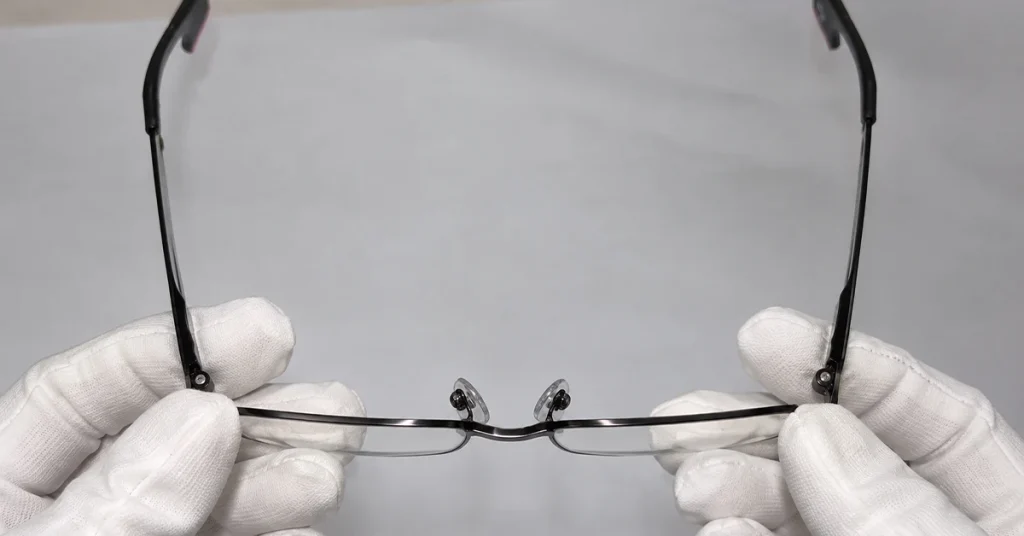
- A: Using detection pliers, angle the nose pad to 45° three times. Rotate the nose pad 90° clockwise along its axis, return it to center, then rotate 90° counterclockwise and return again — this counts as one cycle. Neither the nose pad wiring nor the solder points should break or detach.
- B: Apply a 400g pull-test to check end-piece strength: bend the end-piece roughly 30° inward and return it to position, then 30° outward and return. No cracking or solder separation should occur.
- C: Using a nose-bridge tester, apply pressure to both sides of the bridge for 15–20 seconds — the resulting distance change should not exceed 2mm. Bend the bridge roughly 30° inward and return, then 30° outward and return; twist 30° clockwise and return, then 30° counterclockwise and return. No cracking or solder detachment should result.
-
Color Adhesion Standards
- A: 3M610-1PK tape test
- B: Artificial sweat exposure test
- C: Salt spray test
- D: Aging test
- E: Cross-hatch (hundred-grid) knife test
- F: Metal frames are tested on a 13mm-diameter metal rod; plastic frames on a 25mm-diameter plastic rod. After bending to 180°, neither the color nor the plating layer should peel off.
-
Adhesion Standards for Gems, Logos, Pad Printing, and Lens Coating (100% Inspection)
- A: For gems and logos, apply 3M396 tape to the surface, hold it at a 60° angle, and pull it off quickly — the logo or gemstone must not come loose.
- B: For pad printing and coated lenses, apply 3M610-1PK tape the same way — at a 60° angle, removed quickly — and confirm neither the printing nor the coating lifts off.
-
Component Specification Check — Lenses, Nose Pads, Acetate End Tips, Decorations, Screws, Hinges (100% Inspection)
All parts must match the order and sample requirements; screws and frame fit are allowed a tolerance of up to 0.3mm.
-
Pad Printing Accuracy — Content, Ink Color, Placement, and Completeness (100% Inspection)
Printing must follow the data sheet, with standard color codes such as GUNMETAL, GOLD, BLACK, GREY, BROWN, and WHITE matched correctly to customer specifications.
-
Surface Quality Standards — Scratches, Deformation, Impurities, Haze, Color Loss, Color Variation (100% Inspection)
QC references physical defect samples and evaluates zones A, B, and C of the frame separately.
-
Fit Quality Between Frame Components
- A: Metal temple height must be correct; end-pieces must insert properly into the eye rim — no exceptions.
- B: End-piece height relative to the temple, and temple-to-acetate-tip height, allow an exposed seam of up to 0.1mm; rim-lock misalignment allows an exposed seam of up to 0.2mm.
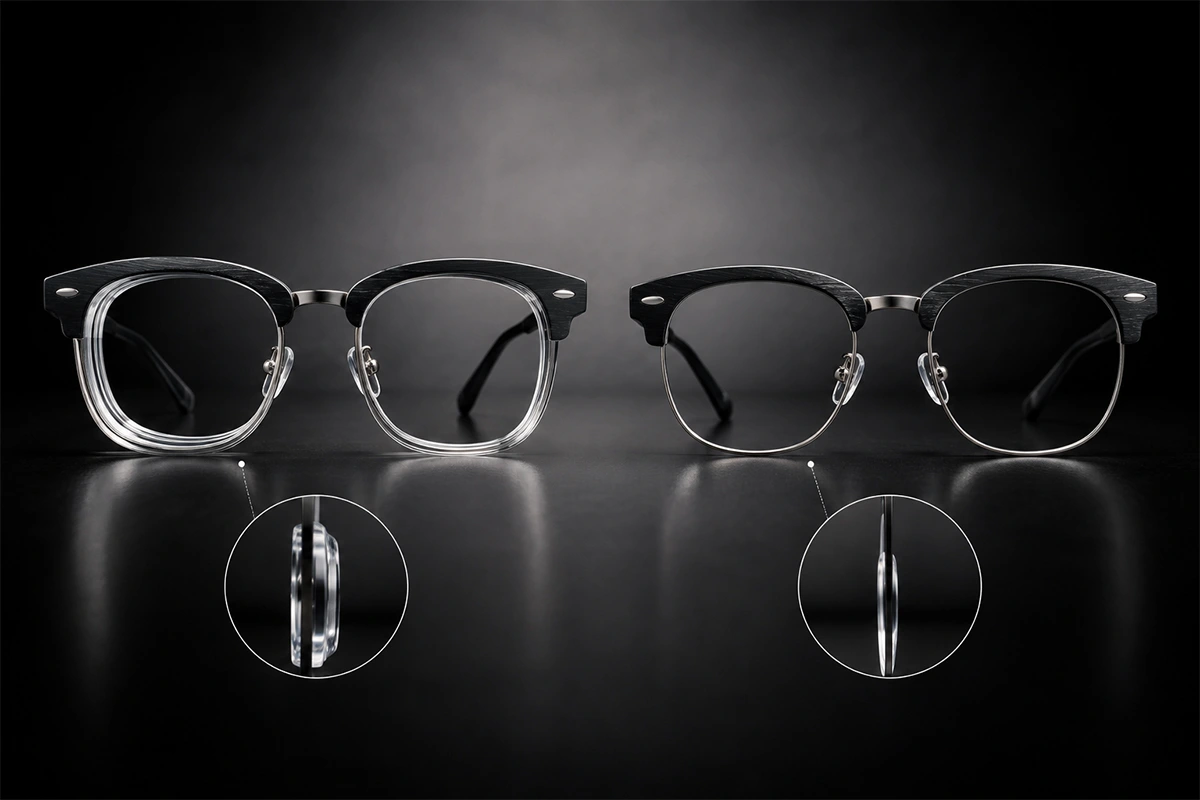
- C: The gap between lens and eye rim may not exceed 0.1mm.
- D: Temple arch tolerance is ±2°.
- E: Eye-rim base inspection (checking lens curvature).
- F: Manual verification of lens-to-frame fit.
-
Welding Quality — Checking for Under-Welding, Over-Welding, or Detachment
Welds must be positioned correctly and cleanly executed — no excess or insufficient welding, and no flash or sagging when checked against the drawings.
-
Face Curvature, Temple Opening Position, Level Alignment, and Acetate Tip Curvature/Length
- Frame face curvature tolerance: ±1° from the drawing spec.
- Temple opening position tolerance: ±2mm; frame level/height tolerance: ±0.3mm.
- Acetate end-tip curvature tolerance: ±2°.
-
Pantoscopic Angle Standard
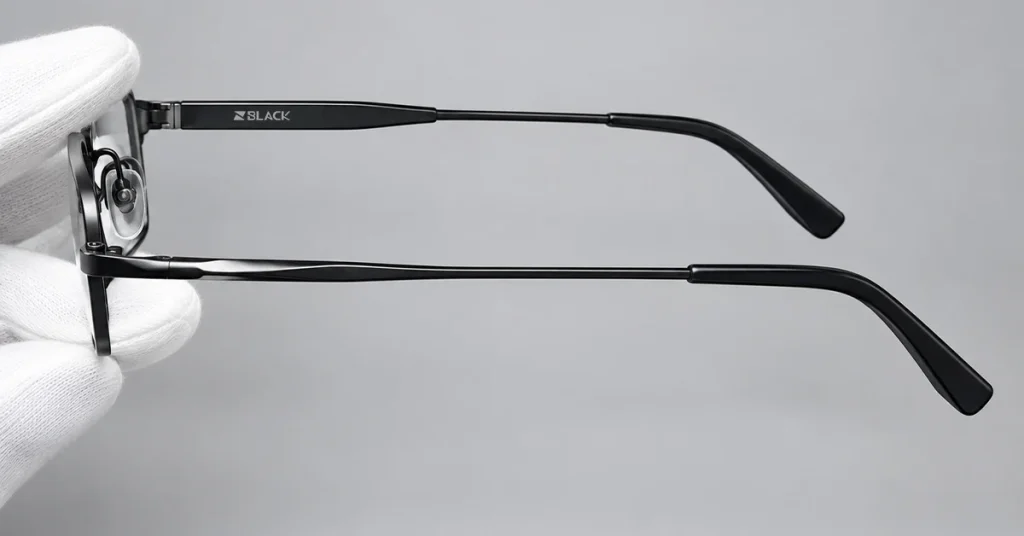
Pantoscopic angle tolerance is ±1°.
-
Hinge Function Standards — Flexibility and Tightness
- A: After opening the temple 20–25° by hand, it should spring back promptly.
- B: At a 45° closed position, the temple should hold that position naturally.
- C: Positioning hinges must function correctly and must never contact the lens.
- D: At a 90° opening, the temple should not swing open or closed on its own.
-
Temple Height Consistency and Cross-Alignment Across Pantoscopic Angles
- A: When closed, temples should sit naturally at 90° without tilting.
- B: Closed temples should generally align in a straight line, with up to ±1° of cross-variation allowed (except for specialized designs).
- C: Internal deflection refers to the temple’s inner curve being symmetrical on both left and right sides.
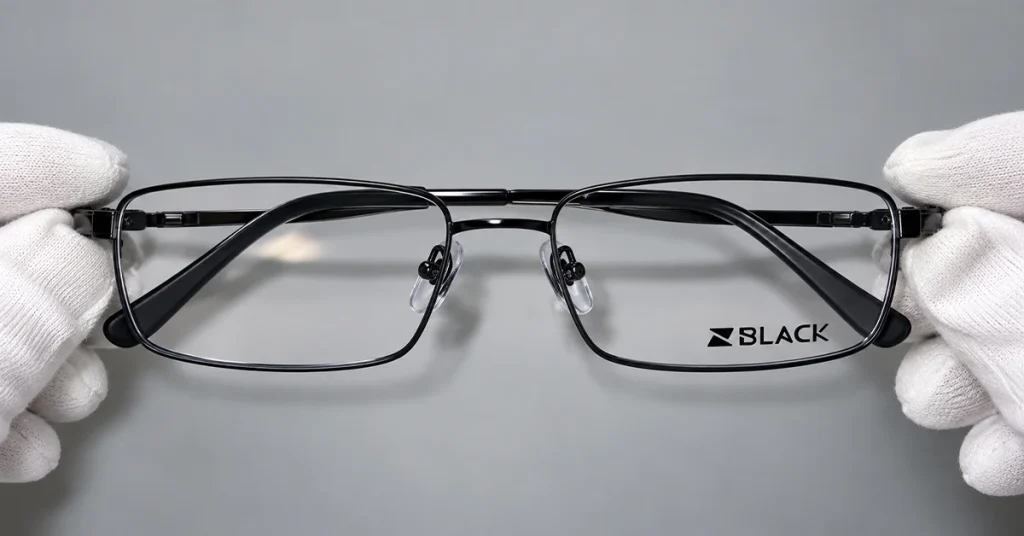
High-quality eyeglass frames combine comfort, durability, and style — fitting properly, lasting over time, and reflecting the wearer’s personal taste. Understanding how to evaluate frame quality matters whether you’re buying glasses yourself or partnering with a custom sunglasses manufacturer to design sunglasses and build your own eyewear brand.